


Listeners:
Top listeners:
00:00
00:00
volume_up
chevron_left
-
 play_arrow
Revolution Radio Your home for the best variety of Christian music
-
 play_arrow
Heartland Newsfeed Radio Network Heartland Newsfeed Radio Network
-
play_arrow
Heartland Newsfeed Radio Network (Abovecast Backup) Heartland Newsfeed Radio Network
-
 play_arrow
Home For The Holidays Radio
-
 play_arrow
How Do Other Countries do Healthcare? Andrew Heaton, Sally Primus
OP-ED: USPS didn’t fail. Congress broke it.
AD
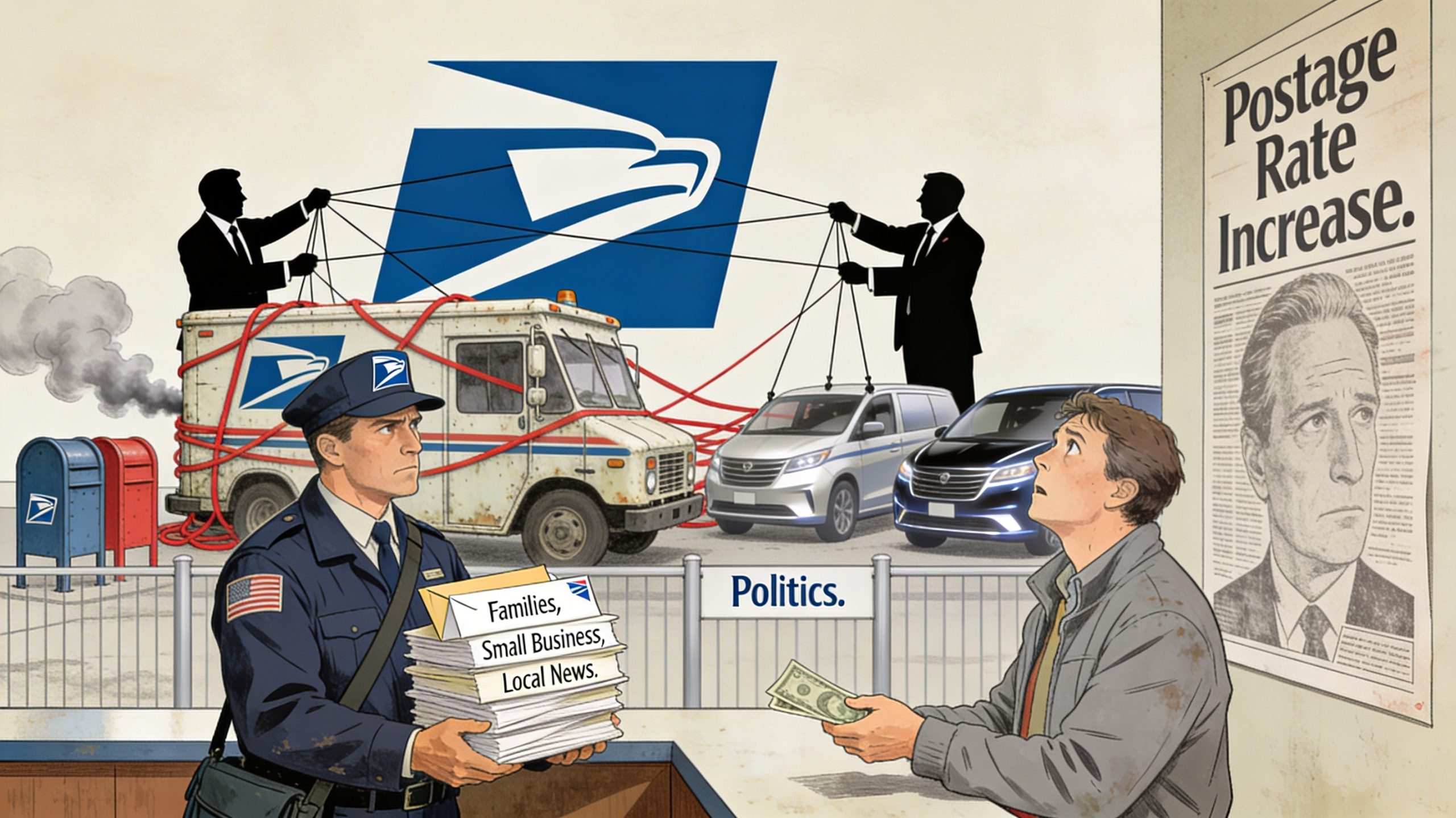
Walk into any post office today, and you’ll see the same depressing ritual. Yet another rate‑hike notice taped to the wall, another few cents slapped onto the price of a stamp, another hit to people who didn’t cause this mess in the first place.
The story politicians tell is that the United States Postal Service (USPS) is bloated, incompetent, and losing money. But here is the damning truth: the government can’t run anything right. The truth is uglier and more bipartisan: Congress deliberately sabotaged USPS’s finances. They would then insulate it from real competition, and are now quietly using ratepayers as the bailout mechanism.
2006: The year Congress broke a working system via “reform by sabotage”
Until the mid‑2000s, USPS was remarkably close to what limited‑government types claim to want: a self‑funded public service that basically broke even. They delivered to every address and did not rely on regular tax subsidies. It was far from perfect, but it was financially stable on its own terms.
That changed in 2006 with the enactment of the Postal Accountability and Enhancement Act (PAEA). In the name of “reform,” Congress ordered USPS to pre‑fund decades of future retiree health benefits on an aggressive schedule that no private company or federal agency had to meet. Overnight, an organization that was more or less paying its way was recast on paper as a fiscal disaster.
This wasn’t the market speaking. It was a statute. Congress took a functioning, if creaky, postal system and buried it under a politically manufactured liability bomb. Congress would then hold it up as proof that the government can’t run anything efficiently.
A manufactured crisis, not market failure
The losses that followed weren’t driven primarily by sudden incompetence or runaway labor costs. They were driven by a mandate that would have crippled almost any enterprise, public or private. Lawmakers effectively used USPS as an off‑budget accounting tool while pretending nothing had changed.
If you wanted to design a case study in how to make a public service look like a failed business, you’d do almost exactly what Congress did in 2006.
USPS incompetence vs. the reality of political control
For years, critics have mocked USPS as the epitome of bureaucratic waste. Slow lines, surly clerks, and red ink as far as the eye can see. That myth has been convenient for politicians who don’t want to admit their own role in blowing a hole in the balance sheet.
Libertarians are right to point out that state monopolies breed complacency. But, in this case, the “failure” was engineered from above. The people making the rules in Washington—Democrats and Republicans alike—dictate what USPS must do. They dictate where USPS must go, what prices it can charge, and what lines of business it’s allowed to enter. Workers and local postmasters are just downstream of that.
USPS: A monopoly without the freedom to compete
USPS occupies the worst of both worlds. It has legal monopolies on certain types of mail. But there is something they lack: the freedom that a private firm would have to set prices, drop unprofitable services, or pivot into new businesses. It can’t even fully capitalize on the network it already runs without asking permission.
In a genuine market, a company facing declining letter volumes and rising costs would radically restructure or die. USPS is forbidden from doing the first and is too politically important to be allowed to do the second. So it staggers along in a gray zone—neither truly public and accountable, nor truly private and competitive.
Price hikes at USPS are silent, regressive taxation
Today’s leadership calls its 10‑year strategy “Delivering for America.” In practice, that means chasing “financial stability” by squeezing more revenue out of each piece of mail while volume keeps falling. That’s why you now see postage increases multiple times a year.
From the customer’s perspective, this is indistinguishable from a stealth tax. Congress is too cowardly to have an honest debate about what a universal postal network should cost and who should pay for it. As a result, it lets USPS quietly ratchet prices upward and call it an “adjustment.”
We, the consumer, did not cause their cost problems
We’re lectured about labor costs, fuel, and transportation as if those justify endless hikes. From a libertarian standpoint, that’s ass backwards. Those are management and policy problems, not moral obligations for the user.
If the fleet is full of outdated gas and diesel hogs, that’s a capital allocation failure. If routes are bloated and technology is outdated, that’s a governance failure. The answer to bad decisions is not “charge people more and hope they don’t notice.” It’s to change the decisions—or change who gets to make them.
The rot started in 2006, and the duopoly made it worse
Republicans and Democrats both have fingerprints all over this. One Congress saddled USPS with prefunding mandates. Later Congresses refused to fully unwind the damage. Administrations of both parties have used the Postal Service as a political football while dodging the structural questions.
Under the Trump Administration, USPS leadership became a front in broader partisan fights, from mail‑in ballots to operational slowdowns. The message was confused but consistent. Demand that USPS behave more like a business, while still denying it the legal framework or liberty to actually operate as one.
Culture wars are just a distraction from USPS’s structural failure
Fights over ballots, slogans on trucks, and symbolic “reforms” are useful distractions. They keep people arguing about which party “supports the post office.” They should instead be asking why Congress keeps dictating terms to an entity it refuses to fund properly or fully.
For libertarians, the pattern is familiar. Central planners break the system, blame the operators, then use the failure they engineered as justification for more control.
What a real reform of USPS looks like
The current arrangement is indefensible from almost any principled standpoint. If you believe in robust public services, USPS is being starved and sabotaged. If you believe in markets, it’s a politically managed quasi‑monopoly that can’t fail and can’t truly compete.
Real reform would mean choosing one of a few honest models:
- Treat it as infrastructure: Admit that a universal postal network is a public good. Fund its universal obligations transparently from the federal budget. Stop pretending it should behave like a private business while shackled by Congress.
- Shrink the mandate and open the market: Narrow the universal service obligation. Allow real competition in letter mail. Let private carriers take over routes where they can do the job better. Accept that some remote service will either be subsidized or simplified.
- Hybrid with real autonomy: Keep a basic USO but convert USPS into a more independent entity with genuine freedom to set prices. Shed unprofitable lines, diversify services, and compete—while also removing political micromanagement.
What we have now is none of the above. It’s an unaccountable compromise where Congress gets symbolic control, management gets to blame “costs,” and the public gets stuck with higher prices and fewer options.
Bringing it home: Our postal system as a poster child of national failure
On the ground, this isn’t an abstract debate. It’s higher mailing costs for families sending bills and ballots. It is merely another squeeze on small businesses shipping orders. It is yet another headwind for independent newspapers and magazines that rely on the mail to reach readers.
Every stamp price increase is a reminder that the people who broke the system are using your mailbox to balance their books. Whether you lean libertarian because you distrust centralized power, or you just want a functioning postal service that doesn’t gouge you, the result is the same. You are paying for choices you never got to vote on.
Stop blaming the counter clerk
The next time you wince at another postage hike, don’t take it out on the clerk behind the glass. Definitely don’t take it out on the mail carrier on your street. They aren’t the ones who wrote the 2006 law, politicized leadership appointments, or locked USPS into a no‑win business model.
Blame the people who insist on running a national postal network by statute while refusing to either fund it honestly or free it to compete. If they want universal service, they should pay for it transparently. If they want market discipline, they should stop blocking the market. What they shouldn’t do is keep mugging the Postal Service in a back alley and then handing you the bill at the counter.

Jake Leonard, a broadcast media and journalism veteran, is the editor-in-chief of Heartland Newsfeed. Leonard is also GM and program director of Heartland Newsfeed Radio Network, wrestling editor and contributing writer for Ambush Sports, a contributing writer for My Sports Vote and Midwest Sports Network, and a former contributor to Bleacher Report and Overtime Heroics. He resides at home in Nokomis, Ill. with his dog Buster.
AD
 Nokomis, IL
 81°F
Feels like 85°F°L: 81° H: 81°
81°F
Feels like 85°F°L: 81° H: 81°
AD

AD