



Listeners:
Top listeners:
00:00
00:00
volume_up
chevron_left
-
 play_arrow
Revolution Radio Your home for the best variety of Christian music
-
 play_arrow
Heartland Newsfeed Radio Network Heartland Newsfeed Radio Network
-
play_arrow
Heartland Newsfeed Radio Network (Abovecast Backup) Heartland Newsfeed Radio Network
-
 play_arrow
Home For The Holidays Radio
-
 play_arrow
How Do Other Countries do Healthcare? Andrew Heaton, Sally Primus
Understanding Specialized Equipment for High-Density Storage
AD
Maximizing warehouse space is a top priority for any growing business. As inventory expands, traditional storage methods often fall short, leading to inefficiencies and increased operational costs. This is where high-density storage systems come in, allowing you to store more products in less space.
Implementing these systems requires more than just new racking; it demands specialized equipment designed to operate within these compact environments. Understanding the specialized equipment needed for high-density storage is vital to making an informed decision for your business.
Why Specialized Equipment is Necessary
High-density storage systems, such as drive-in, pallet flow, or narrow-aisle racking, are designed to significantly increase storage capacity by reducing aisle space. While this is great for maximizing floor space, it creates unique challenges for material handling.
Standard forklifts are often too wide or lack the maneuverability needed to navigate these tight spaces. Attempting to use conventional equipment in a high-density environment can lead to damaged products, compromised racking, and serious safety risks for operators. Therefore, investing in the right specialized equipment is not just an option—it’s a fundamental requirement for a successful high-density operation.
Key Equipment for High-Density Systems
Selecting the right equipment depends heavily on the specific type of high-density racking you have installed. Let’s explore some of the most common pieces of machinery used in these specialized environments.
Narrow Aisle (NA) and Very Narrow Aisle (VNA) Forklifts
As the names suggest, Narrow Aisle (NA) and Very Narrow Aisle (VNA) systems are characterized by their slimmed-down aisles. This design can increase warehouse storage capacity by up to 50%. While they are great for added capacity, you should consider the pros and cons of narrow aisle pallet racking before you install it.
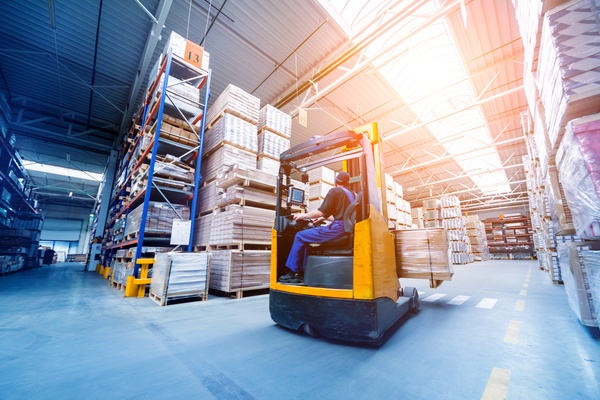
- Reach Trucks: These are the workhorses of many NA environments. Reach trucks have a specialized mast that can extend forward to place or retrieve pallets, allowing them to operate in aisles that are much narrower than those required for standard counterbalance forklifts.
- Turret Trucks: VNA systems take space optimization a step further, often requiring turret trucks. These highly specialized machines feature a mast that can rotate 90 degrees, allowing the operator to access both sides of the aisle without turning the forklift itself.
Equipment for Drive-In and Drive-Thru Racking
Drive-in and drive-thru racking systems allow forklifts to enter the rack structure to store and retrieve pallets. This “last-in, first-out” (LIFO) or “first-in, first-out” (FIFO) system is ideal for storing large quantities of similar products.
- Standard Counterbalance Forklifts: In many cases, standard forklifts can be used with drive-in systems, provided they are compact enough to fit comfortably within the lanes. Operators need to be highly skilled to navigate these tight confines without causing damage.
- Reach Trucks: Narrower reach trucks are also a popular choice, as their smaller chassis provides more clearance, reducing the risk of collision with the racking uprights.
Making the Right Choice for Your Warehouse
Choosing the correct equipment for your high-density storage system is a critical decision that impacts your entire operation. Before making a purchase, consider your current racking system and your business’s budget. It’s better to manage the upfront costs of equipment with the long-term ROI for the new space utilization.
AD
 Nokomis, IL
 62°F
Feels like 62°F°L: 62° H: 62°
62°F
Feels like 62°F°L: 62° H: 62°
AD

AD