

Listeners:
Top listeners:
00:00
00:00
volume_up
chevron_left
-
 play_arrow
Revolution Radio Your home for the best variety of Christian music
-
 play_arrow
Heartland Newsfeed Radio Network Heartland Newsfeed Radio Network
-
play_arrow
Heartland Newsfeed Radio Network (Abovecast Backup) Heartland Newsfeed Radio Network
-
 play_arrow
Home For The Holidays Radio
-
 play_arrow
Democracy Now! 2026-09-03 Thursday
Grain Belt case heads back to appellate court
AD
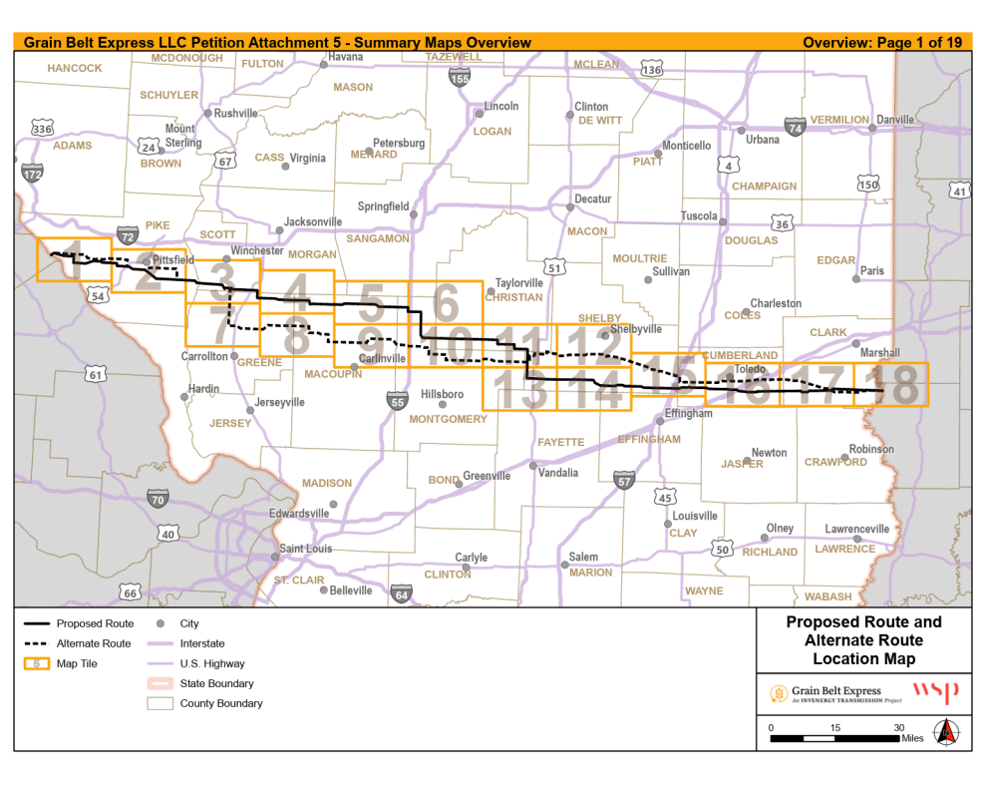
SPRINGFIELD (FarmWeekNow) — The Illinois Supreme Court reversed a lower court’s ruling that Grain Belt Express (GBX) did not demonstrate sufficient financing for a proposed multi-state transmission line that crosses nine Illinois counties and remanded the rest of the case back to the appellate court.
In a 6-0 ruling, the court said GBX met its duty under the Public Utilities Act to show it could finance the project “without significant adverse financial consequences for the utility or its customers.’
“The ICC’s correct interpretation of the plain and unambiguous language … not only aligns with the Act but also with the legislature’s express commitment to reduce the state’s dependency on fossil fuels and move to renewable energies,” Justice Mary K. O’Brien wrote.
The project, which has faced multiple legal challenges during the past decade, was designed to transport electricity generated by wind and solar farms across four states. The project is being developed by the Chicago-based company, Invenergy.
Case history
In 2024, the Fifth District Appellate Court reversed the Illinois Commerce Commission’s (ICC) granting of a Certificate of Public Convenience and Necessity (CPCN) to GBX. The decision followed an appeal of the ICC order filed by Illinois Farm Bureau and landowner groups. The court ruled that GBX failed to prove the required criteria that it is capable of financing the project.
In July 2025, the U.S. Department of Energy (DOE) canceled a conditional $4.9 billion loan for phase one of the GBX transmission line, noting, “After a thorough review of the project’s financials, DOE found that the conditions necessary to issue the guarantee are unlikely to be met and it is not critical for the federal government to have a role in supporting this project.”
The CPCN issued by the ICC requires GBX have funding for the entire project in place before construction begins on any easement property in Illinois. GBX was not granted eminent domain authority by the ICC as part of the CPCN.
Opposing views of the ruling
“Illinois Farm Bureau is disappointed by the ISC’s decision but looks forward to the 5th District Appellate Court hearing the case to address all of the other issues, including our constitutional challenges,” IFB Associate Counsel Laura Harmon said.
A GBX spokesperson told Capitol News Illinois after the ruling the company was pleased with the decision and that it plans to move forward as a privately financed project.
Breakdown of the Illinois Supreme Court case
Invenergy representatives testified to the Illinois Supreme Court about Invenergy’s experience in financing similar transmission line projects, its skilled management team, established relationships with commercial lenders, and interest in the project and the renewable energy industry.
“Proof of GBX’s current and present financial capability was not a condition precedent to the issuance of the CPCN,” the court wrote. “Instead, evidence of the industry’s method of financing the construction of large-scale energy projects, along with unrefuted evidence that such projects do not generate revenue until regulatory permits are issued and customer contracts are executed, supports the ICC’s decision to issue a CPCN to GBX.”
The court rejected IFB’s and concerned citizens’ claim the ICC has traditionally required applicants to present sufficient financial documentation to satisfy the statutory requirements, as “Those applicants were existing public utilities with physical plant and infrastructure already present in the state.” Harmon notes that the court’s decision fails to address the fact that in the original GBX and the Rock Island Clean Line cases, both entities produced financial documentation to support the statutory requirement.
The nearly $7 billion, 800-mile proposed high-voltage direct current transmission line was originally designed to carry wind-generated power from western Kansas, across Missouri and Illinois, to Indiana, where it would connect to two regional power grids. But according to recent reports, Invenergy may connect natural gas or coal generation for the GBX line, which is contrary to the purported purpose of allegedly supporting clean energy.
Grain Belt case background
Illinois Farm Bureau and landowner groups first challenged the ICC’s approval of the project in 2015.
In 2018, a state appellate court ruled the ICC lacked authority to grant a nonpublic utility company a CPCN under the expedited review process of the Illinois Public Utilities Act. The court also ruled GBX didn’t meet the definition of a public utility.
The Illinois General Assembly passed the state’s 2021 Climate and Equitable Jobs Act (CEJA) in 2021, allowing GBX to apply for and obtain approval of its project from the ICC, which again took up consideration of the project in August 2022. The legislation included a provision specifically designed for GBX that allowed ICC to issue permits to a “qualifying direct current applicant,” which the law defines in a way that specifically describes GBX and its proposed project.
The ICC in March 2023 voted unanimously to approve the project, citing the special provisions under the law.
IFB, landowners, and other opponents then challenged the permit on several grounds, including the provision of the state’s Public Utilities Act that requires applicants to demonstrate they are capable of financing the proposed construction without adversely affecting the utility or its customers, which the Illinois Supreme Court addressed.
They also challenged the provision of CEJA that was specifically designed to facilitate the project, arguing it violated the Illinois Constitution’s equal protection and separation of powers clauses as well as its limits on “special legislation.” They also argued the ICC failed to make findings required under other applicable sections of the Public Utilities Act.
These challenges were not addressed by the state’s high court and will be remanded back to the appellate court for further consideration.
Matter is under appeal
While the matter is on appeal, impacted landowners may receive correspondence from GBX to negotiate an easement and grant it the right to survey, Harmon said.
“There are serious concerns with the easement and right of entry consent for survey and testing as proposed by GBE, including but not limited to the proposed price structure (only paying 20% up front but receiving all easement rights), lack of legal description for the easement allowing it to be placed at any location on the property, inclusion of overly broad access easement with no additional compensation, and an overly broad stated use for the easement permitting telecommunications,” she said.
While GBX has the right to survey, impacted landowners or their agent, under Illinois law, have the right to be present during the survey, and are entitled to prior notice and compensation for any damage caused by the surveying activities.
“Unless and until you retain counsel to represent you, GBX and their land agents will continue to contact you to engage in easement negotiations and property access agreements to survey,” Harmon said. “We recommend that you retain counsel ASAP, and please reach out to your county Farm Bureau if you need a referral. If you have already retained counsel but continue to be contacted by GBX, please advise your counsel so they may direct GBX that all communications be handled by your attorney.”
Illinois farmers are not against electric energy development or green energy, counsel stated during oral arguments in November, adding: “They just want energy for public use in Illinois from responsible actors that comply with the law, since they and the next generation of farmers will be compelled to interact with these energy providers that build, maintain, repair and keep the line safe on their farms and next to their homes.”

Tammie Sloup is a general assignment editor for FarmWeek and FarmWeekNow.com. A native of Ottawa, Ill., the Eastern Illinois University alum previously worked as a regional editor for Shaw Media.
Similar posts
AD
 Nokomis, IL
 78°F
Feels like 79°F°L: 74° H: 78°
78°F
Feels like 79°F°L: 74° H: 78°
AD

AD